
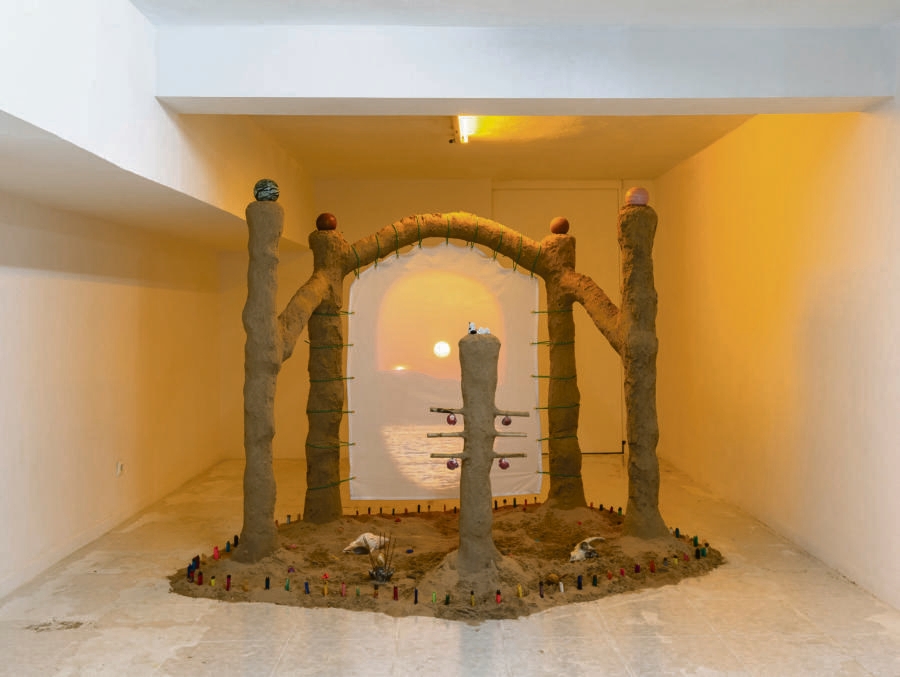
There is a particular kind of artist who emerges from the landscape itself, shaped by the place that raised them while constantly pushing beyond it. Julià Panadès is one of those artists.
Born in Ses Salines, Mallorca, in 1981, Panadès belongs to a generation of creators who move fluidly between disciplines, mediums and ideas. Trained in design, illustration, and animation in Barcelona, he now extends his practice far beyond the traditional boundaries of contemporary art. His installations, objects and conceptual interventions draw from ecology, spirituality and the everyday materials of modern life, transforming them into works that feel both poetic and quietly provocative.
At first glance, Panadès’ work can appear playful and intuitive. Beneath that surface, however, lies a deeper inquiry into the tensions that shape our contemporary moment: nature and consumption, belief and scepticism, permanence and impermanence.
“My work encompasses the social and the existential,” he says. “Being born in Mallorca surrounded by nature made me a lover of the planet and interested in psychology, spirituality and alternative therapies.”
These influences are rooted in his upbringing. With a psychologist father and a yoga teacher mother, Panadès grew up between rational thought and spiritual curiosity, an intersection that continues to inform the themes of his work today. Critics have sometimes described him as a modern-day shaman, an artist whose practice blends ritual, symbolism and material experimentation into a distinctly contemporary language.
Across installations, sculptures and site-specific works, Panadès often works with humble or found materials, objects gathered from the landscape or fragments of everyday life. In doing so he questions both our relationship with the environment and the systems of value that shape the art world itself.
“I’m interested in exploring the parallels between contemporary art and the spiritual world,” he explains. “Concepts like impermanence and transcendence are linked to spiritual experience, and I apply them to my artistic practice.”
Over the past decade his work has appeared widely across Spain and internationally, with exhibitions in cities including Amsterdam, Helsinki, London, Berlin, Bogotá, Paris and Milan. Yet despite this global reach, Mallorca remains central to his identity.
“Life in Mallorca is luxurious,” Panadès reflects, “but it’s like a small town, and sometimes it’s good to go out and receive new inputs.”
That tension between island intimacy and the wider world continues to shape his work. Through projects that merge ritual, environment and contemporary culture, Panadès invites us to reconsider the ordinary materials around us. In doing so, he reminds us that some of the most compelling art begins with curiosity and the courage to keep searching.
Robert Meeder
Cinema a la fresca / Open air cinema (2024) installations view, found objects and video; as part of the exhibition Pa, suor i pols‘ / Blood Sweat and Dust, Julià Panadès, at Fran Reus Gallery; photo Grimalt Blanch