
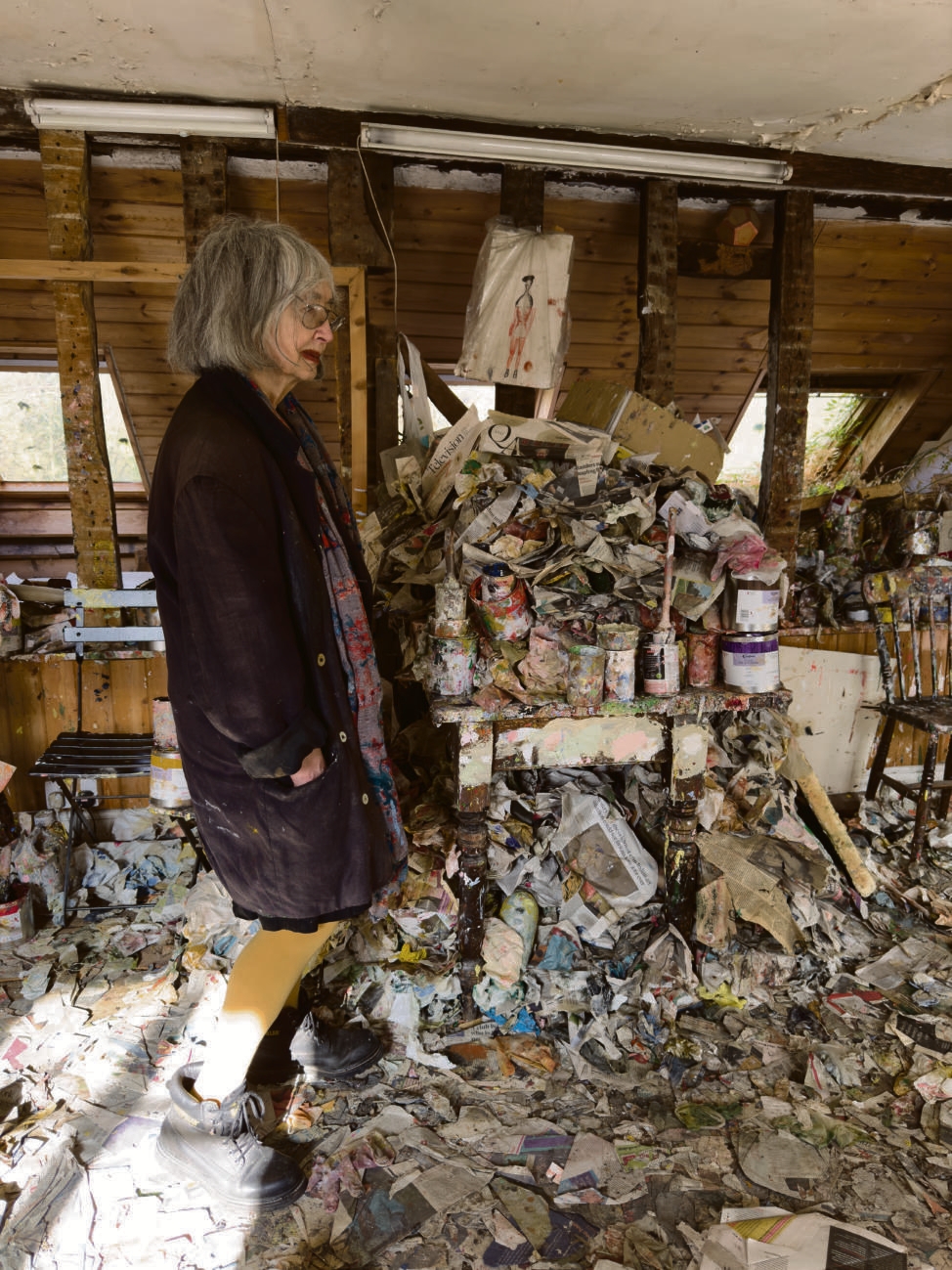
Portrait of Rose Wylie by Jürgen Teller. Below : Frick, oil on canvas. Yellow Strip, 2006, oil on canvas. Both paintings courtesy the artist and David Zwirner. “Yellow Strip depicts several footballers in movement from different perspectives at the same time, operating in the same way as medieval embroideries such as the Bayeux Tapestry, in which key figures appear more than once in a single scene. American artist David Salle comments on Wylie’s work, “She gets a lot of mileage out of painting eyelashes, as well as full skirts, soccer balls being kicked, brick walls and ocean waves – anything that can be represented by rhythmically organised lines and sets of lines. Her streamlined figures project speed and immediacy, but they are not just hieroglyphs. The handmade quality, the feeling of an image arrived at through careful in-themoment looking, is always present.”
— Royal Academy of Arts
Rose Wylie, a prime example of growing old gracefully aged 92, with a bob of ash blonde hair and dark eyebrows, is youthful, with traces of her former beauty. She is inquisitive, staring beneath her dark eyebrows through spectacles, she does not miss a beat. Rose’s paintings form a panoply of the past and the present; memories, from as far back as the W.W.II, painting doodlebugs in a yellow sky, to the present; recent newspaper headlines, fashions and daily life, all rendered in ways accessible to all. Popular culture and history come in to play; portraits range from the Queen of Sheba to the footballer John Terry. Her paintings are immediate and spontaneous and she eschews perspective in a playful witty way and yet one can frequently spot correct Renaissance perspective.
She has lived in her 17th century cottage in an old Kent village in the ‘Garden of England’, where serried orchards stretch as far as the eye can see, for over 60 years with her late husband, the painter, Roy Oxlade and their three children. Roses’s story is one of many women artists, who put her brush down to raise their children. However since her husband’s death in 2014 Rose’s art has risen to higher realms. Since her seventies Rose has become a resounding success with solo shows including Tate Britain (2013), Space K Seoul, Turner Contemporary, Margate (2016), The Serpentine Gallery (2017), and where I am and was was her debut solo in the U.S at the Aspen Museum in Chicago while in 2016 she was awarded the OBE.
During the late 1960’s she taught art sporting white fishnet tights. In 1968 they moved to Kent when her husband was appointed head of the art department in Sittingbourne College of Further Education; and she has lived there ever since. Little has changed since they moved in except for her overflowing creative endeavour. She remained the ‘artist’s wife’ until the 1980s when the children left and she had space for a studio. “I put all my energy into making jam, soups, Christmas cards, curtains and raising our children.” At 45 she went to the Royal College to study cultural history and her dissertation was on the language of drawing and how it is taught in English art schools. She is not a part of a generation of figurative painters; she has forged her own path.
Her house smells of woodsmoke, paint and turps. In mid winter heat billows from a heap of smouldering embers in a high mantled fireplace in the hallway; the dining room is in the conservatory where Russian vine and wisteria dangle through the window panes. The dining table is enticingly laid with silver candlesticks and fortified wines. The garden is left to grow wild with roses, ferns, meadow flowers and nettles where serpentine paths lead to benches overlooking meadows and orchards.
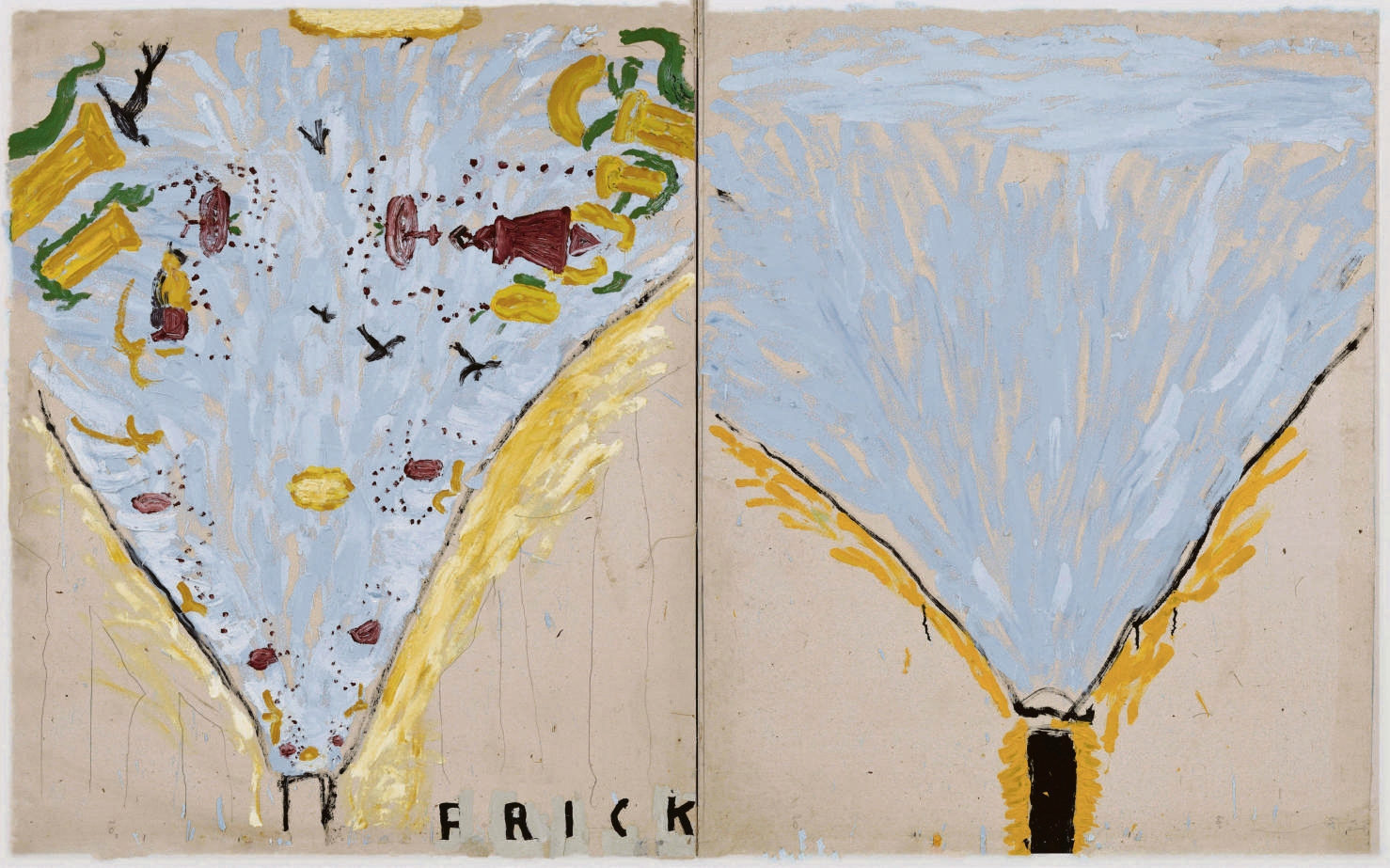
A pantry well stocked with champagne and cooking apples leads into an outdoor studio, for completed paintings. One of them is ‘Frick’ a diptych destined for her retrospective at the Royal Academy. Rose, a Senior Academician is the first British female to have a one woman exhibition in the main galleries at the Royal Academy.
‘Frick’ is a striking optical illusion like the Rubens vase which can be seen as a vase or two faces in profile. In Rose’s triptych the three canvases in cobalt blue skies and grey tones can be seen as alley ways in a North African town or erotically as wide open female legs. This is the genius of her work, far more subtle than Rubens’s ‘Vase’, or the rabbit trick image and ‘My Wife and Mother in Law’ by W.E Hill. The imagery is inspired by the recently refurbished Frick Museum where a rococo ceiling fresco has been restored and has the same vivid cobalt blue.
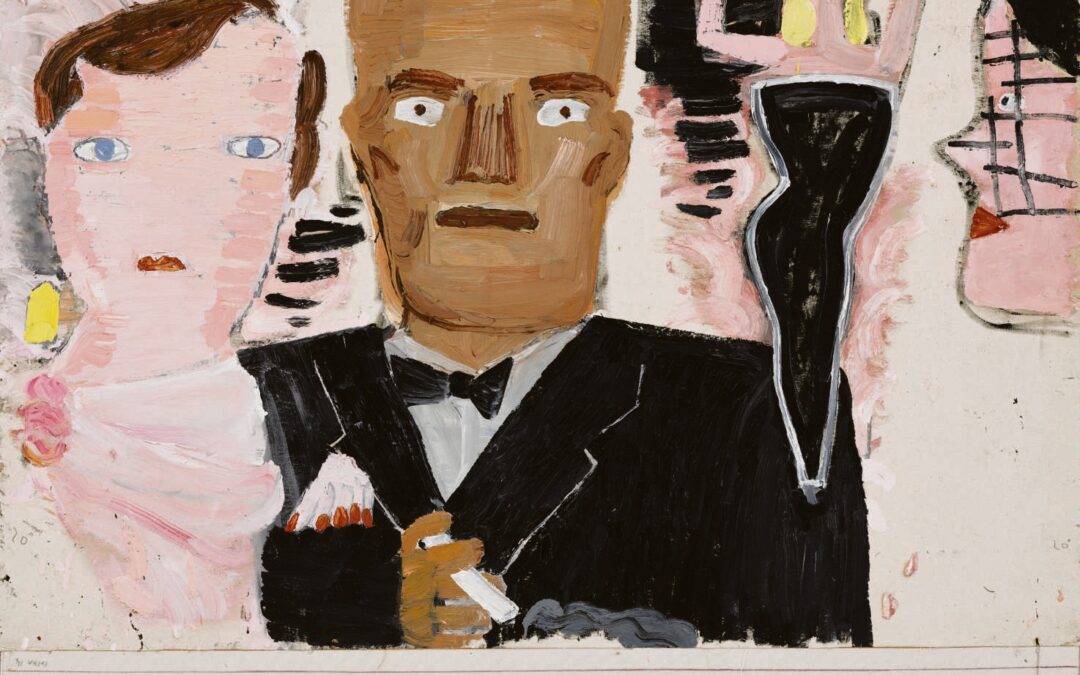
If on first impression Rose’s paintings appear naive, they could not be less so. An uninitiated might say the inevitable ‘a kid could do that’, the paintings are not childish but child-like and her seemingly simplistic style belies clever sophisticated ideas questioning visual representation. Rose argues “Why is it childish just because it doesn’t look like a da Vinci?” Large, unstretched, unprimed canvases are stapled to the wall; if the composition spills over she simply staples another piece of canvas on.
Embracing the past and the present, from Pharaonic and Assyrian temple friezes to colourful popular culture, she celebrates celebrities. Kate Moss in her pants, Serena Williams in a postpartum body suit, and ‘Nicole Kidman in a Pink Frock’ to name a few, are witty erotic images. Henry V often pops up in her portraits, with a pudding bowl haircut, as her paternal grandfather James Hamilton Wylie, the Oxford historian, wrote ‘The Reign of King Henry the V.’
Her expansive canvases cover all the walls in her studio, paint splattered surfaces sing with vibrant colours and the plug sockets are positively roccoco. The studio is a virtual mini mountain range of geological stratae – newspapers, magazines; decades old or from recent days, crustacean shoes, dried up paint globules, paint cans, tubes, rags, dried flowers and a kitsch pink telephone form a gigantic garbage heap so spectacular, a Korean Gallery imported it lock stock and detritus, to exhibit as an installation recently. The mini mountains of tabloids and broadsheets are a stockload of imagery. “I see subjects everywhere, you use what you’ve got.”
Rose speaks eloquently in clipped short phrases. Turning to a canvas she is painting from a 2,400 years old mosaic excavated in Turkey it depicts a skeleton holding a drinking vessel alongside bread, a wine amphora — feasting, votive candles and an ancient Greek inscription ‘Be cheerful enjoy your life’. Rose comments “it is from the school of Athens, the boy is Aristotle… he looks like a nice boy.” As a witty apercu she has spelt Turkey as Turky. Then she swiftly moves onto politics, “Trump wants to ‘cleanse’ museums’ history and wipe out all imagery of black people. My politics are green. We should eat local stuff, carrots and swedes. Not cherries from Washington- how obscene, when they grow in abundance in Kent. Some people say ‘you must be having a whale of a time doing just what you want to do’— But it is not like that, you’re always frightened to start. I might work until three in the morning. The age thing was difficult. Art is the best thing for coming back to; you just need a pencil and a bit of paper.”
Celia Lyttelton
Everything I paint is instinct.
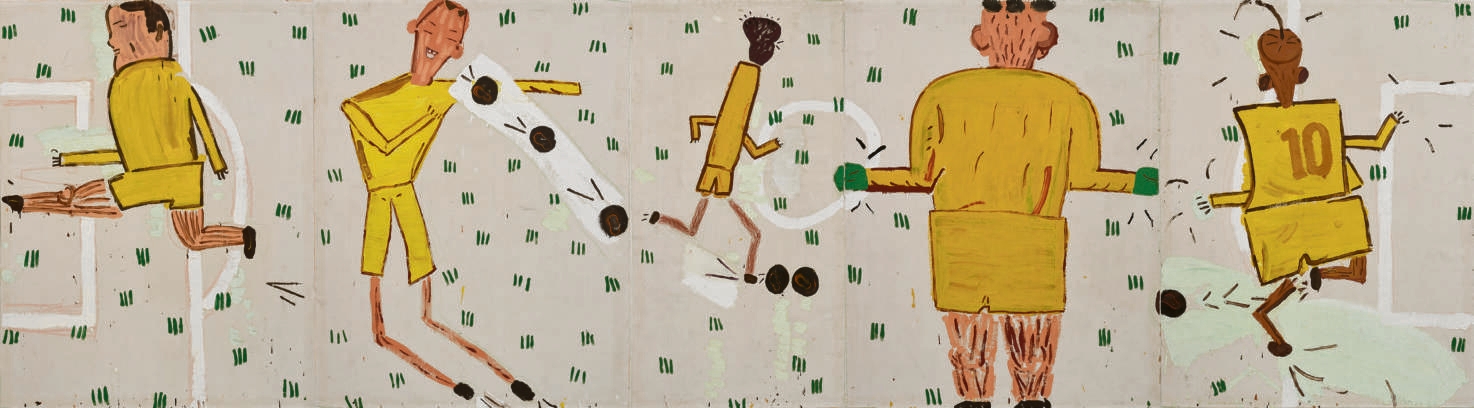
Yellow Strip, 2006, Oil on canvas
Courtesy the artist and David Zwirner
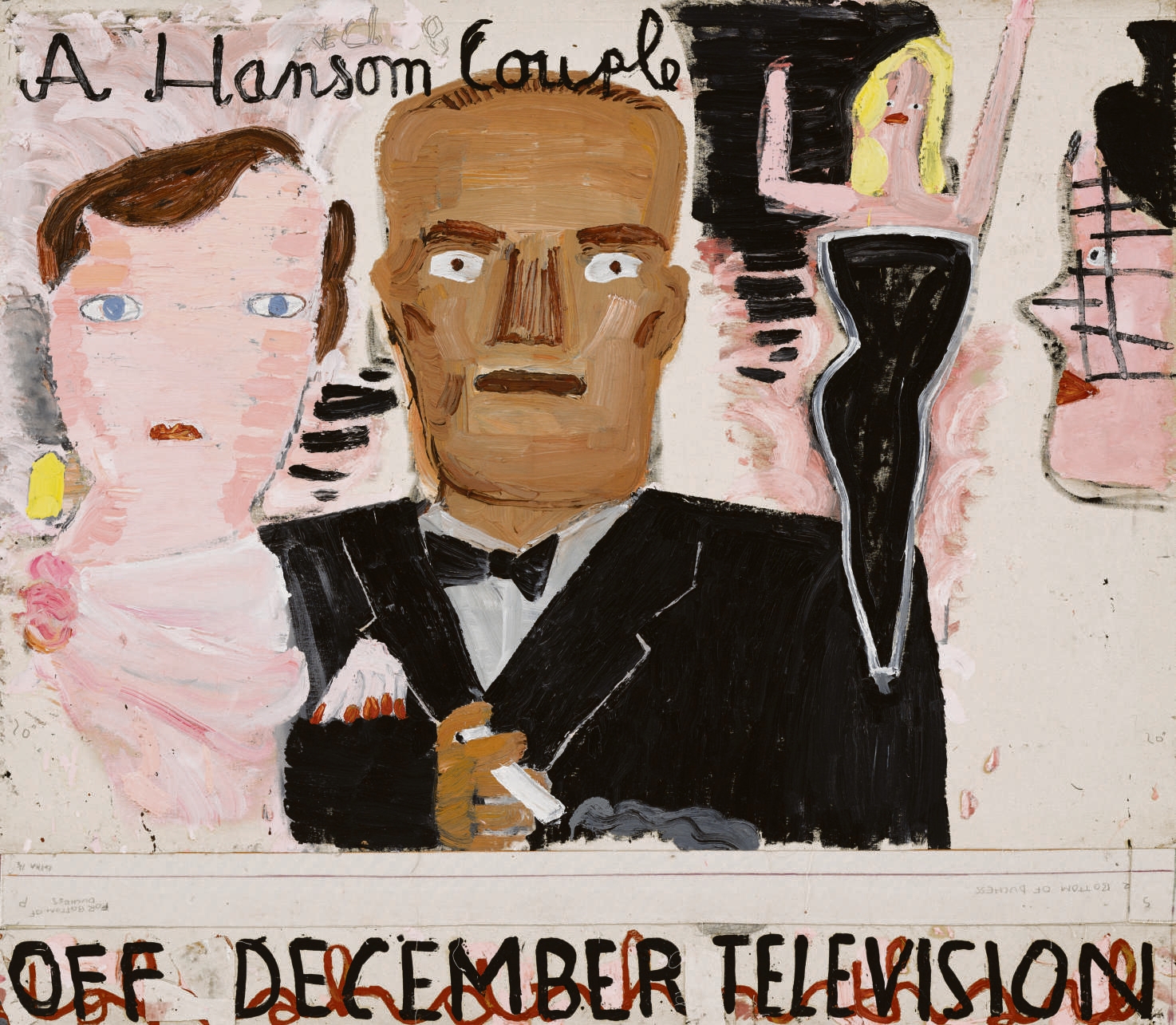
A Handsome Couple 2022, Oil on canvas. Courtesy Edwin Oostmeijer.
Rose Wylie
The Picture Comes First
Royal Academy of Arts, London
through April 19 2026