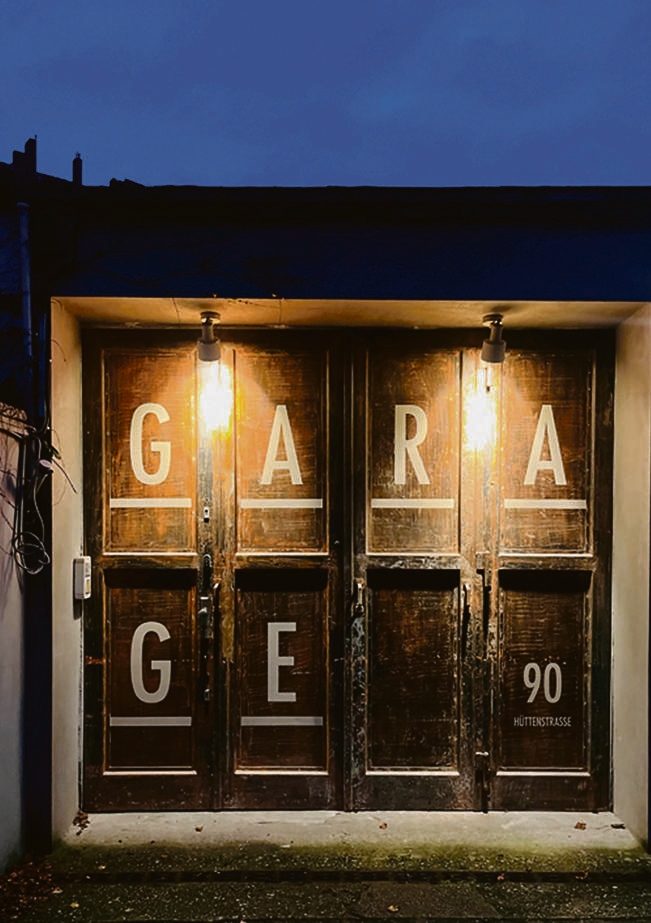
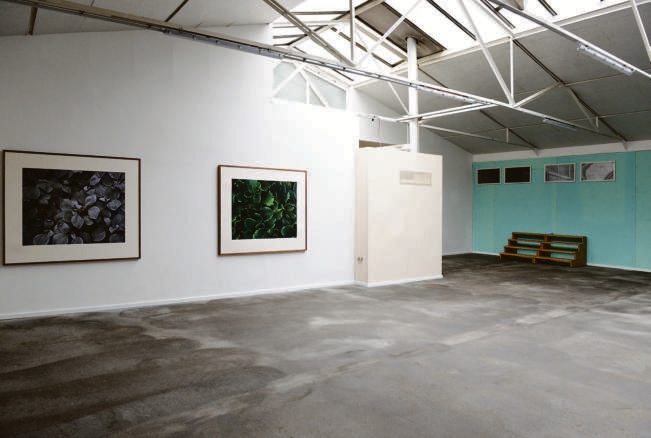
‘Kunsthalle’ – is created by one artist for the art of others. Accessed through a large gate painted ‘GARAGE’ in an innercity backyard we enter a surprisingly spacious hall complex. The Thomas Schütte Stiftung’s new art venue is individual, charming, flexible, generous, spacious: numerous rooms flow into one another, some bathed in daylight streaming through the glassed-in pointed roofs. Some of the rooms are wood panelled, while the asphalt-floored main hall leads up to a turquoise back wall featuring a slice of a wooden staircase. Behind the coloured wall are several artist studios yet to be occupied.
GARAGE, a place for art and encounters, was Thomas Schütte’s spontaneous reaction to a “warehouse for rent” notice on a post – and one thing led to another. „We had just sold a large sculpture, had furnishing materials from a 2024 Anna Viebrock Skulpturenhalle exhibition and a carpenter’s dream team at the ready,” explains Schütte. The pieces from Anna Viebrock‘s exhibition explain the paneled floors and the centrally placed wooden steps on which we are conducting our interview.
For the first few years the GARAGE programme is reserved for friends of the foundation; “Photosynthesis, Primordial Forms of Life” by Gino Bühler is the inaugural exhibition followed by Anna Zimmermann, “Echoes,” in April.
GARAGE is Thomas Schütte Foundation’s first venue in Düsseldorf, but their Skulpturenhalle Neuss has been inviting greats of the art world since 2016 – among them Mario Merz, Richard Deacon, Paloma Vargas Weisz, Richard Long, and Bruce Nauman to name a few. The last exhibition featured Reiner Ruthenbeck, a colleague from the Düsseldorf Art Academy, as was Erinna König who exhibited in 2020; this spring Jane and Louise Wilson’s exhibition ‘Countermeasures’ is curated by Juliane Duft, the socio-political work of the British twins being lent an added twist by the fact that the venue is situated on a former NATO and U.S. missile base.
In 2014, Schütte wasn’t actually intending to create a private museum but rather was
looking for a storage facility, his extensive collection of own works largely benefitting the logistics of the vast number of exhibitions he juggles. Creating his own space ensured the safety of the sculptures and even paid off financially: “A suitable storage space costs as much as real estate on the Königsallee (Düsseldorf’s equivalent of London’s Sloane Street) – and even then you‘re not sure of the conditions…” explains Schütte, and thus the idea of Sculpturenhalle Neuss was born: a work of art and exhibition venue built right on top of Schütte’s new underground storage facility. Another smaller sister building has already been added since.
2024-2025 was not only a lucrative year in terms of sales, but also an extended birthday celebration for Thomas Schütte, who turned 70 in November 2024. Solo exhibitions around the world started with the Thomas Schütte retrospective in September 2024 at the Museum of Modern Art (MoMA) in New York. Thomas Schütte’s exhibition spanning the entire upper floor attracted a queue of visitors winding around the block morning to night. “The preparations for the MoMA exhibition took 12-13 years; the curator herself worked on it for over nine years, she was absent for a few years in between and then returned […]. One complication was that, for insurance reasons, I was not allowed to touch my own works – […],” recalls Thomas Schütte.
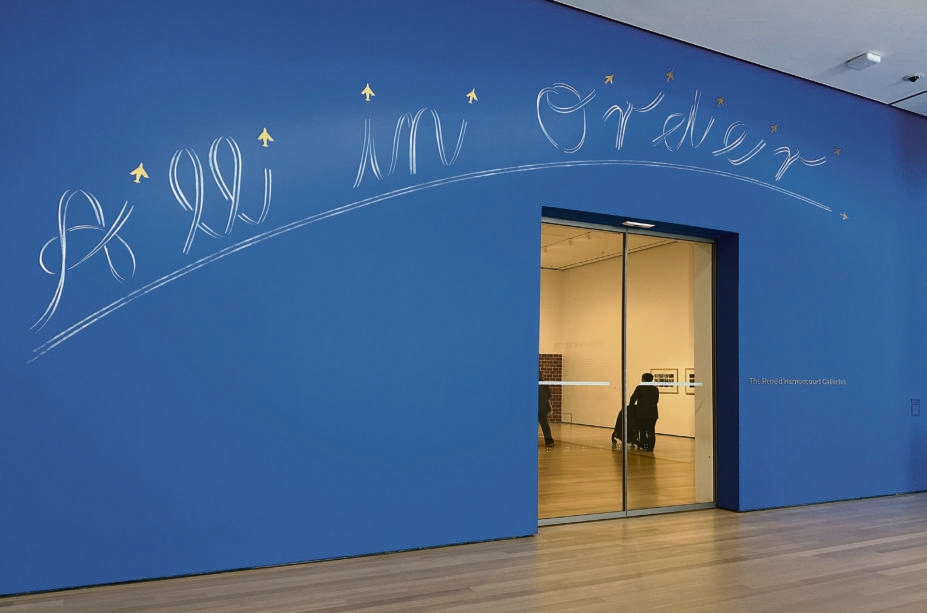
The blue entrance featured “All in Order” in two white lines – chemtrails from the small jet planes, shooting off to the sides. “I had painted the jet plane lettering on the ceiling of Walther König‘s first store in Cologne in 1981 – then the ‘postcard’ store, now a souvenir shop. Ludger Gerdes and I designed the store and took the S-Bahn to Cologne every day with buckets of paint. The walls are Trompe-l’œil panels and for the ceiling I thought it would be funny to have “All in Order” written by military jets.”
It was in 1978 that Schütte first put this slogan on a wall – borrowed from the equally satirical title of the film ‘Tout va bien’ by Jean-Luc Godard and Jean-Pierre Gorin on the unfulfilled promises of the 1968 revolts. The ‘78 version was designed in the “VAG Rounded” font, the lettering used in the Volkswagen logo, a company that successfully swept its Nazi past under the carpet during the post-war boom. Schütte‘s jet plane chemtrail lettering at Walther König’s store – and then at MoMA – reminds us that it was commonplace to see jet planes in German skies throughout the 70s and 80s. The occupying powers retained their military bases in Germany for almost half a century after the Second World War and the RAF Germany still flew training exercises two to three times a week with reconnaissance aircraft and fighterjets. In fact, the last British combat troops did not withdraw from Germany until 2019.
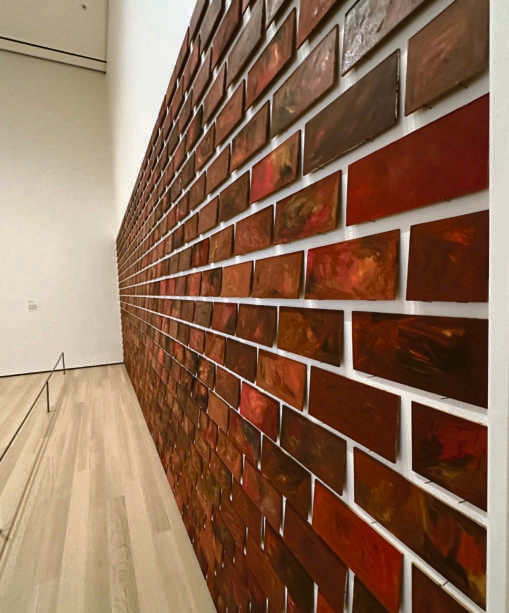
Once past the ‘All in Order’, the MoMA visitor was greeted by “Father State” – a ca 4-metre-high bronze sculpture, placed centrally like a guardian – or an authority figure blocking the way. Behind him stretched the ‘Great Wall,’ 1977: 1,200 hand-painted faux bricks (10 x 20 cm thin hardboard panels covered with recycled canvas and painted), which had once lined the corridor of the Düsseldorf art academy. ‘A stack of painted panels and the entire room could be (re)designed, integrating wall clock, radiators and the door in the work.’
„My first real contact with art was a school trip to Documenta 5 in Kassel1 in 1972 […]. I visited twice, coming to the realization that “anything is possible”. In grammarschool I chose music instead of art, where we (only) listened to vinyls. Even as a child, I had stress-related eating disorders. After school, I refused to do military service and decided never to take exams again, which is why I don‘t have a driving licence.“
“I owe my art career to the ‘numerus clausus:’ due to my bad exam results I could only choose art or religion as subjects. I sent some drawings to the Düsseldorf academy, went on a summer trip forgetting about it – and upon my return found an acceptance letter waiting for me. We had new young teachers, it was a new beginning at the academy, an exciting time, and above all, we learned what not to do. I chose “decoration” as personal subject, something no-one else was doing.“ Schütte thus distanced himself from the popular art forms of the time, such as minimal, pop and performance art, and was already pursuing ideas relating to “architecture, interior & design” back then. „My professors were Fritz Schwegler and Gerhard Richter.
Beuys scared us a little. In private one could get along with him fine, but as soon as more than two people gathered it was a ‘group’ and everything instantly turned into a performance.”
Taboos, the unexpected and (self-)irony; historical, cultural, social and personal processing are themes that frequently appear in Schütte‘s work.
‚Mein Grab‘ (My Grave), 1981, with 25 March 1996 as the proposed date of death, envisages the form of a house with a pointed roof on a columnal base – complete with front garden and fence in the drawings – part of the series “Architectural Models 1980-2006”. Later the “Ghosts” can be interpreted both personally and socially, while the installation “Where is Hitler‘s Grave” (1991) challenges the viewer to confront the rise of right-wing extremism in Germany after reunification.
‚Melonely,‘ 1986, is a gigantic painted wooden watermelon, in eleven pieces placed individually or in groups within the confines of a room, leaning or lying, suggesting a humorous allusion to Minimal Art. The multi-part sculpture is accompanied by watercolours representing the melon pieces in different groupings like people’s portraits. The wordplay in the title refers to the loneliness of the parts and, at first glance, to the oneness of the whole. However, all are of the same size and twelve , not eleven pieces would make a whole – one is missing!
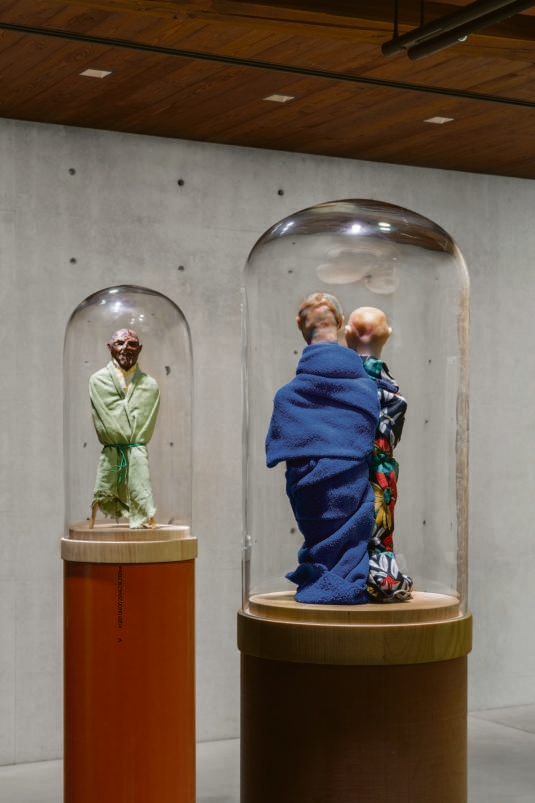
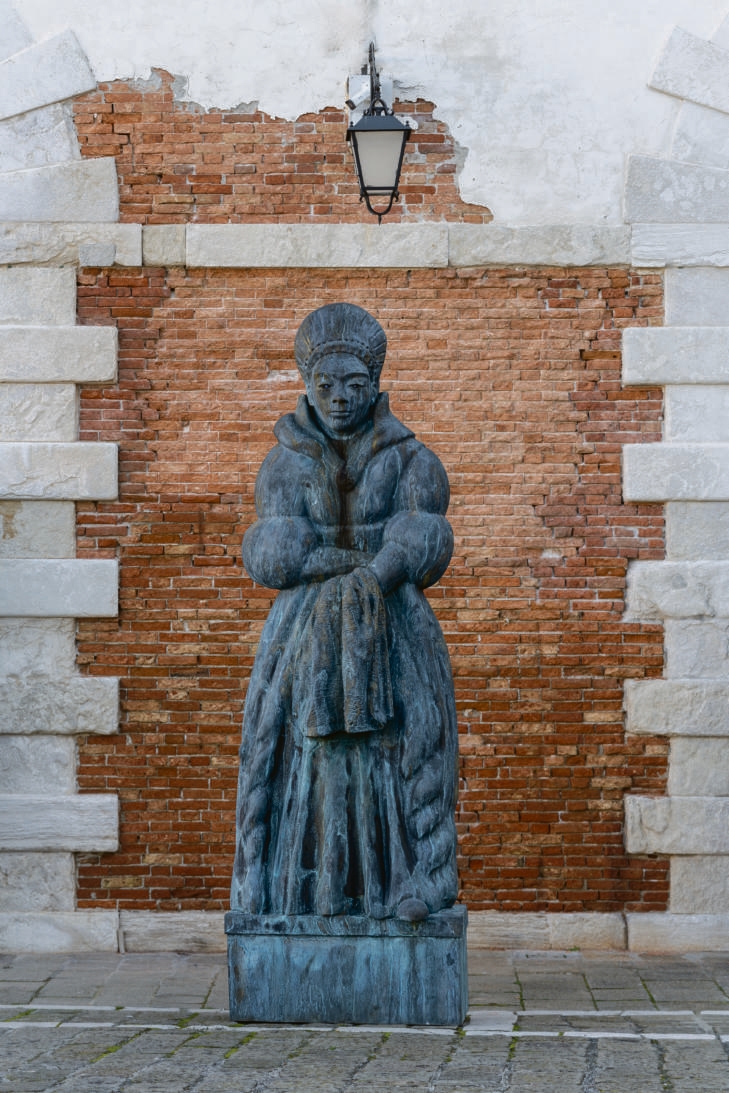
Figures, sculptures and heads, tiny or enormous are made from varied materials such as bronze, polymer clay, glass, ceramic or wood; they may appear individually or in pairs, inseparably entangled like the ‘United Enemies’ or even fused together as in the ‘double heads.’ The bronze “Mother Earth” feels like a counterpart to “Father State”, but it is the monumental version guarding the Palazzo Grassi in Venice, which measures up in size.
Space – whether conceptual, mental or physical – is a central theme in Thomas Schütte‘s oeuvre, and becomes increasingly important over time. While his early architectural models represent three-dimensional mental images and are not necessarily intended as building plans, Thomas Schütte has been realising them architecturally in actual size since 2007. ‘One Man House,’ Roanne, 2007, has been joined by others such as the ‘Blockhaus’ on the Vitra Campus in Weil am Rhein and ‘#32 Ferienhaus T’ in Tyrol, based on the model ‘Holiday Home for Terrorists I, II, III, conceived in 2002 as a space for reflection on 9/11.
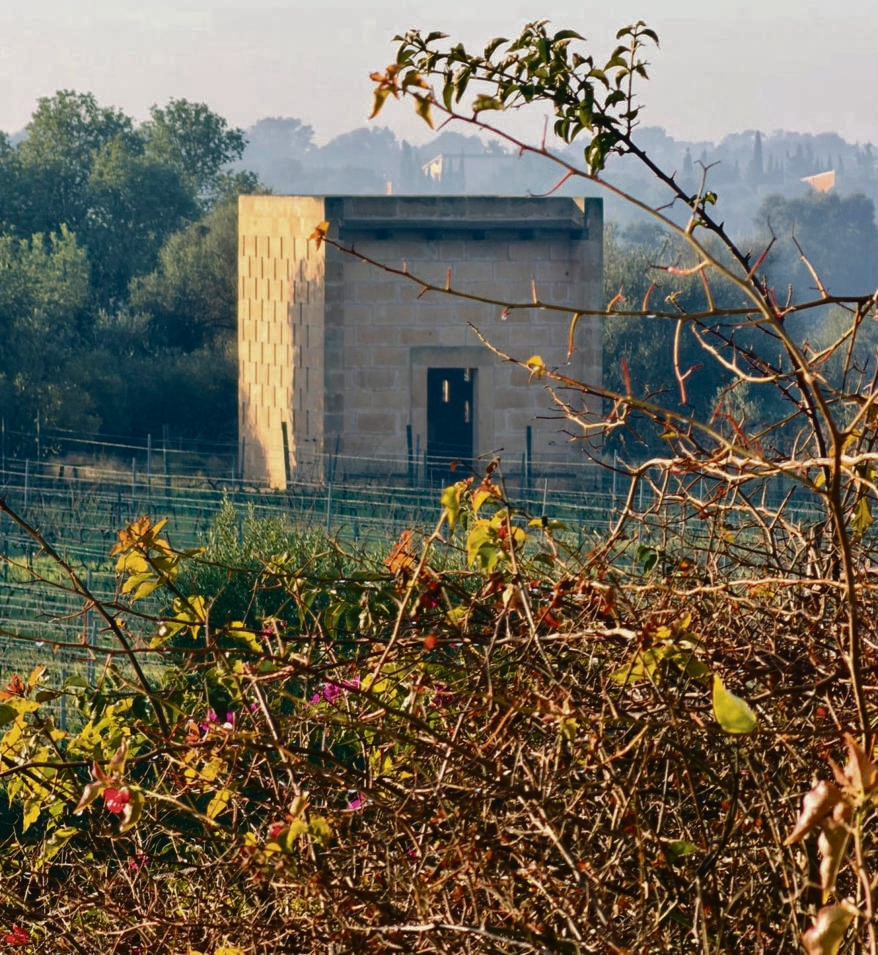
‚Ackermans Temple‘ in Mallorca was built in 2012 in the vineyard of collector and artist Heinz Ackermans. Designed as a cubic temple, it is a mystical place for the reclining female head (2006) laid out inside. The northfacing temple, built in straight lines from local Balearic Marès stone, reveals its wonder upon entering. The vertical brick-shaped hole pattern of the stonework in block formation lets the sun in – rhythmically, moving, dancing with the sun‘s daily arch; indirectly illuminated in partial shade, the beauty sleeps or dreams.
“Heinz Ackermans actually wanted a ‘Father State’ sculpture on his property – but after visiting the site,
I found a building made of local stone much more appropriate, with a bronze woman‘s head in the centre. It was also much cheaper and more logical,”
explains Thomas Schütte.
Finally, Thomas Schütte, who has participated in Documenta in Kassel three times and received the Golden Lion for ‘Best Artist’ at the Venice Biennale in 2005, answers my question about a tip for young artists. „‘Order‘ is the only thing that really helps,“ he replies after a moment of pause – and with that notion we come full circle to the jet planes flying over the Rhine.
Uscha Pohl
1 Under the direction of Harald Szeeman, Documenta 5 focused largely on action and social engagement. Photography and film were included, and broader creative fields such as advertising, architecture, urban planning and science fiction illustration were exhibited alongside traditional art forms such as painting and sculpture.
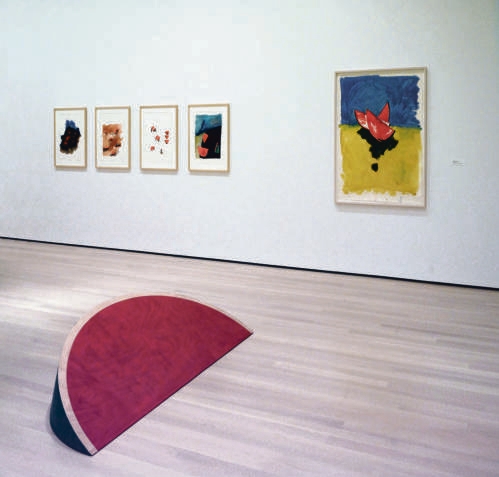
Melonely, 1986, wood, paint, 11 parts 100 x 50 x 230 cm, and watercolours on paper 65 x 50 cm, photo: Luise Heuter © VG Bild-Kunst, Bonn 2026
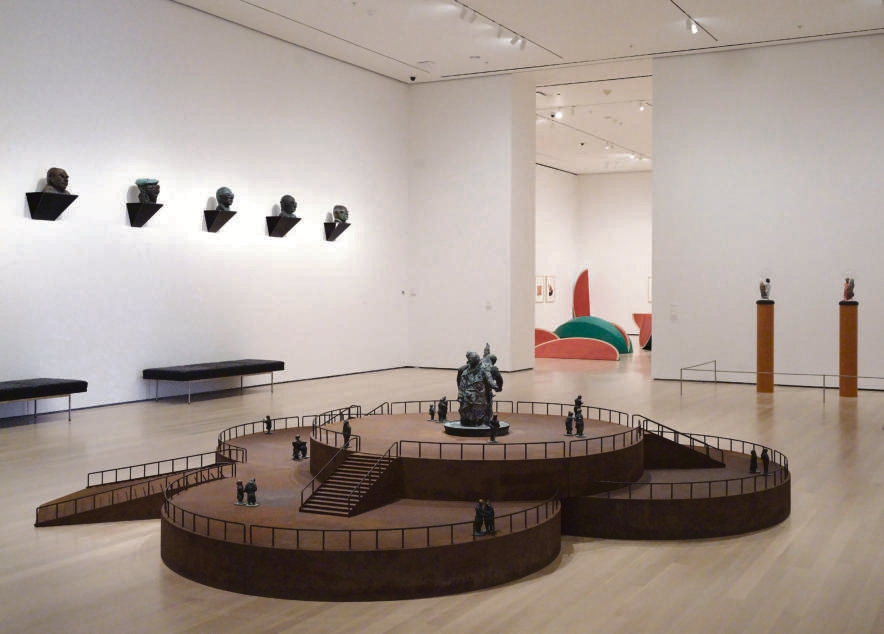
Thomas Schütte retrospective MoMA NY, exhibition view, photo Luise Heuter © VG Bild-Kunst, Bonn 2026
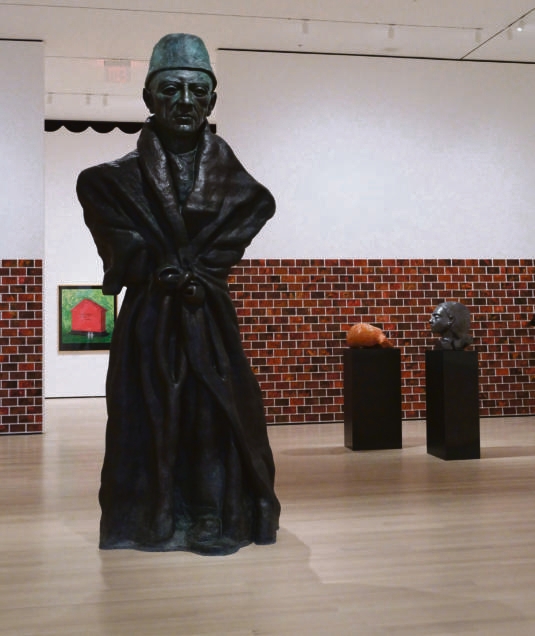
Vater Staat / Father State, 2010, patinated bronze, 373 x 155 x 110 cm; installation view; photo: Luise Heuter © VG Bild-Kunst, Bonn 2026
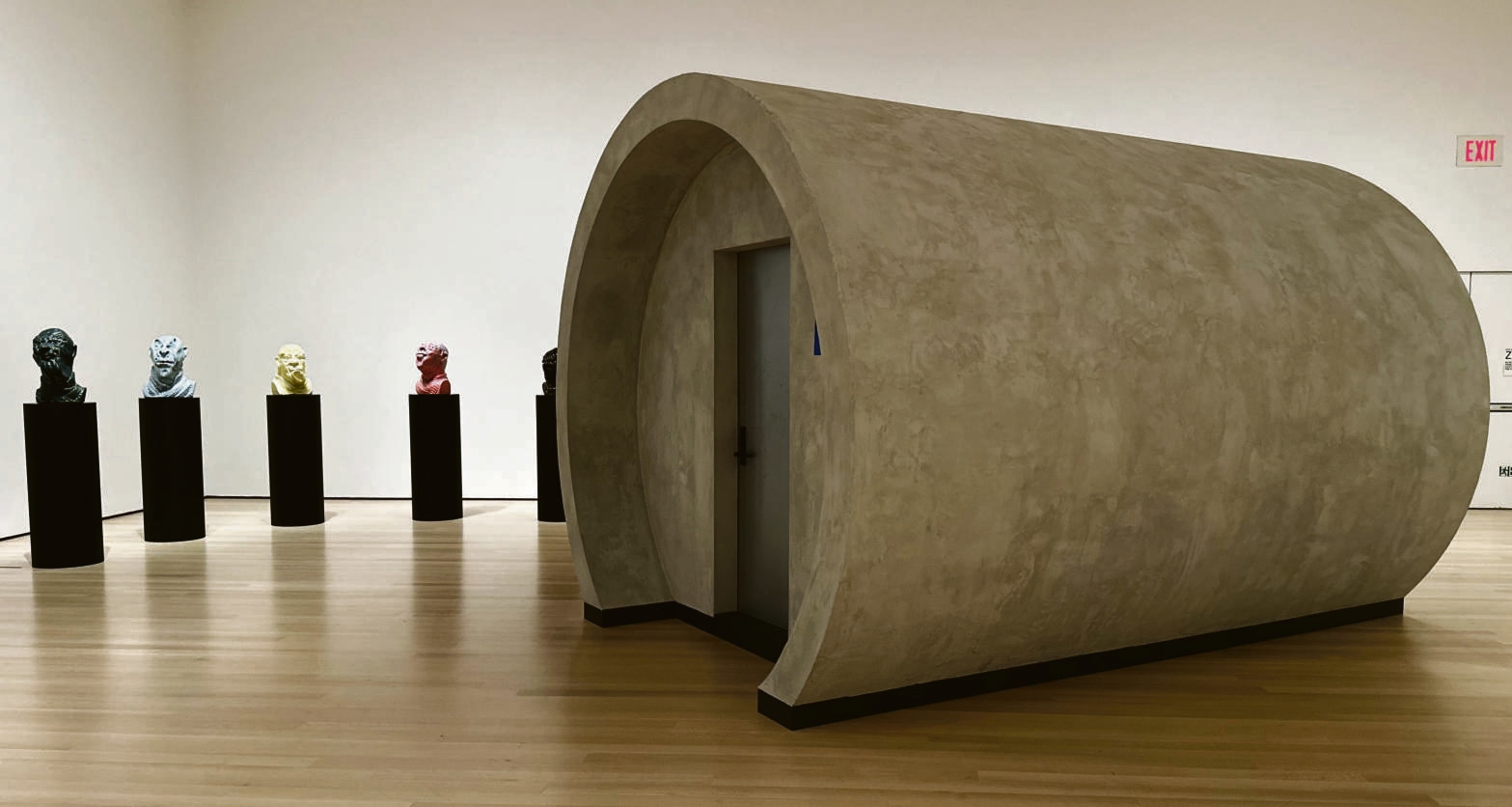
Schutzraum / Shelter, 1986 (exhibition copy 2024), Thomas Schütte, steel and sprayed concrete, 330 x 266 x 433 cm, photo Uscha Pohl
Ackermans Temple
“I had imagined ‘Father State’ as the guardian of the vineyard, explains Heinz Ackermans, “the temple in the end takes on a similar function.” ‘Ackermans Temple’ symbolically and physically connects ‘inside and outside’ or ‘within and beyond,’ shady yet airy it remains cool even in midsummer. What was once a model made of Lego bricks is here realised in local limestone blocks. “The cathedral in Palma is also built of Marès,” elaborates Heinz Ackermans, “while the smooth pebbles of the temple’s floor are from the mainland and a contrast in feel.” The entrance facing north, on the side benches one can rest and marvel at the sun’s daily course casting intermittent light upon the reclining woman‘s head in its seasonal arc.
“Ackermans Temple” in Mallorca can be visited as part of the VIP programme of ART COLOGNE PALMA MALLORCA with a visit to Heinz Ackermans‘ studio.