
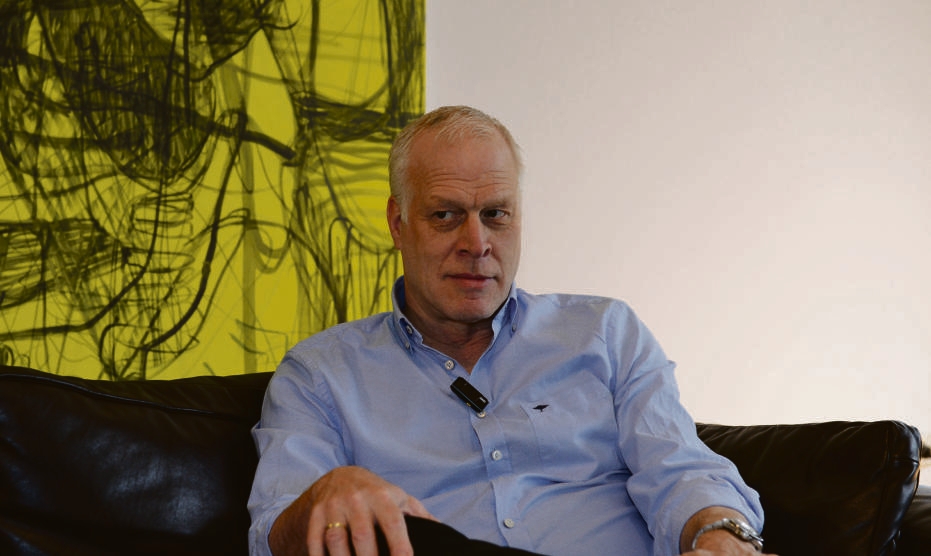
Meeting Daniel Hug on a grey winter day in Germany it is his masterly conjuring of Palma Mallorca and the upcoming Art Cologne on the Balearic island that makes the sun appear from behind the clouds. Resonating the illuminating conversation, the rays start beaming through the tropical leaves on Hug’s spacious terrace in elegant Marienburg, Cologne. In a break from the 19th and early 20th century villas of the area, this building was created by a student of Frank Lloyd Wright.
For eighteen years already Creative Director of Art Cologne, Hug had been headhunted from afar in 2008. Born in Switzerland to his American mother – Hattula Moholy-Nagy was born in Berlin as daughter of Bauhaus master László Moholy-Nagy yet raised in America – Hug himself traded Europe for the US as a child
“My father was a Swiss interior architect and I was born in Zurich. My parents divorced when I was ten years old, and as my mother wanted to finish her PhD in anthropology, in 1979 we moved to Ann Arbor, Michigan, a small university town in the Midwest.”
Growing up, plan A was to become an artist, but fate had something else in mind. “After my BA in Art from the Art Institute Chicago I opened a gallery – to hopefully find another gallery, which would show my work.” Alas his own gallery ended up being so successful that it upended the idea of an artist’s career. “The gallery grew, and eventually moved from Chicago to Los Angeles in 2000. Around the year 2000 my gallery partnership with Michael Hall dissolved and I opened my own [Daniel Hug] gallery which I ran until 2008.”
“I had a lot of art fair experience since in Chicago I was on the selection committee for the Art Chicago Fair for about three years.” He later continued as consultant. “I would advise the fair with a young gallery‘s approach. When Tim Fleming and Steven Cohen started ALAC in Los Angeles I consulted again and helped elevate that fair. I think the best edition would have been my last edition, which was January 2008. Since then I focus on Cologne!”
Hug’s visionary approach befits the pioneering historical fair. “Art Cologne was the first modern art fair, founded in 1967 by Hein Stünke and Rudolf Zwirner in order to support the German art market. They were inspired by the Documenta in Kassel and felt they could make a commercial version of such a large scale exhibition.” An instant success, many fairs followed suit, Art Actuel (today Art Brussels) in 1968, Art Basel in 1970, Fiac in Paris in 1974, the Chicago International Exposition (later Art Chicago) in 1978, Arco in 1982… until 2000 there were only about ten fairs worldwide of any consequence, today we have over a hundred!”
“I would put us in the top five. That‘s not counting the multiple editions of Art Basel and the Frieze fairs: Basel’s five with Qatar and Frieze’s four – they recently acquired Expo Chicago and the Armory Show in New York. So I‘d say we‘re one of the few last independent fairs.”
Art Cologne was the leading fair for contemporary art from its inception in 1967 starting initially with 18 galleries. At the height of the 80s art scene Cologne rivaled New York. In the early 90s then a few factors hit at once: a generational shift, Berlin became Germany’s new cultural center after the reunification and the art market went through a massive correction in 1990/91. “These dates of course also coincide with the financial crisis and the Iraq war. Which also brings us to 2026 – it‘s a difficult time again, different, of course, but difficult for sure.”
“I once had a very long conversation with John Baldessari and his gallerist, Margo Leavin who was the ‘grande dame’ of the Los Angeles art scene. She told me ‘When times are good, you save money because you‘re always going to have bad times.’ And Shaun Caley Regen told me that after she and Stuart Regen opened Regen Projects in 1989 they had about one month of great sales. And then for the next four years they only sold small things – little tiny things.
Today, I would say it‘s not close to being anything like it was in early 1990s.”
“The 1980s was rife with speculation driven by the galleries. Over the last 20 years, this speculation has been driven by the auction houses. In the 1980s, Sotheby‘s, Christie‘s or Phillips wouldn‘t touch contemporary art, no piece of art less than ten years old. But that changed in the 90s.
I remember a Richard Prince work selling at Phillips in 1997 for an absolute record amount for the time – I want to say $700,000, maybe it was only $70,000, but it made the news. That started this intrusion of the auction houses. A slowdown in 2026 I would esteem more a market correction where a marketing reality had gone overdrive. True art has to provide a reflection and some insight into who we are today and help us grow and understand the world that we live in.”
ART COLOGNE PALMA MALLORCA
The Mallorquin contemporary art scene has evolved enormously over the past two decades, with the establishment of the Museu Es Baluard d’Art Contemporani de Palma being a major influence.
“In order for an art fair to succeed, you need an art existing microcosm or art ecosystem, consisting primarily of artists and galleries. If you have the artists, you have the galleries, and if you have the galleries and artists, you have the collectors. With those three, eventually institutions follow and you have a healthy art ecosystem. That is the basis for having a strong regional to national to international fair.“
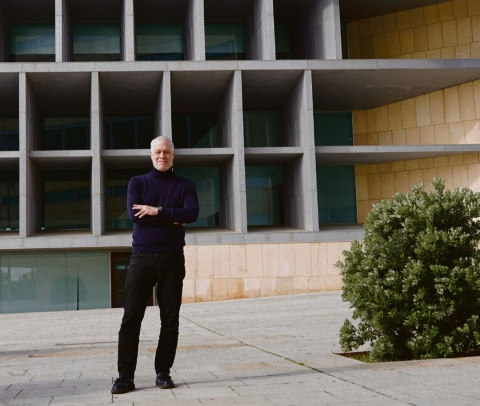
“We were approached about two and a half years ago by the Art Palma Contemporary Gallery Association to create a new art fair.“ The new Congresshall on Palma Bay with a seafront of nearly 350 meters sealed the project. “The Palau de Congressos by Spanish architect Francisco Mangado is a fabulous building. The fair is arranged in two parts, GRAN SALÓ and PARKOUR. In PARKOUR you walk through these fantastical hallways and plazas, before entering the GRAN SALÓ – big hall; upstairs is another large hall with a view and a rooftop deck, restaurant and bar. I would say the PARKOUR is a bit more radical, pushing directions and the GRAN SALÓ is more conservative, but this has nothing to do with the age of the gallery. Eventually we will also involve the two amazing auditoriums for videos and film screenings.“
“Mallorca is basically 1½ – 2 hour flight from every major city in Europe with budget flights almost every day. It‘s absolutely ridiculous how close or how connected it is to Europe; it has fantastic weather and the high tourist season doesn’t start until May 1st.”
Rudolf Zwirner and Hein Stünke created the fair in 1967 to support the German art market and galleries, who in turn support the German artists. The purpose of Art Cologne Palma Mallorca is to ultimately support the Mallorquin art market and their artists. It’s not like we take our brand and stick it in the sand – something like that would only work short term. Today the Spanish economy is the strongest growing economy in Europe. It‘s pretty amazing how big the Spanish art market is – very similar in that sense to the German art market.”
“When things kind of slow down, we have to become creative and come out with new ideas on how to present art, how to make an art fair interesting again. Of 88 galleries that we admitted to the to the Palma fair, the largest block are galleries from Spain, about 29, and then from that block 14 galleries are from Mallorca. It is very important that we support the local galleries, as that‘s our purpose.”
“Palma is also very beautiful as a city with architecture from ancient Moorish structures to the Gothic architecture of the cathedral, to the narrow streets, and the Art Nouveau architecture from the last turn of the century is fantastic. It has an intimacy that is quite perfect. It reminds me a lot of the how Basel was in the early 90s. You can visit three galleries on opposite sides of Palma on foot in 30 minutes.”
Cologne has a population of one million and Mallorca as an island is very similar in numbers. Additionally of course there are all the international people who happen to have a home there or come for holidays. So you‘ve got a double whammy, with a local and international audience. All the key elements are in place for it to make sense. I forgot who said this, but it resonates: “when times are bad, it’s a good time to expand and do something new, to do the unexpected.”
Uscha Pohl
The nonprofit Moholy-Nagy Foundation was founded by Hattula Moholy-Nagy, László Moholy-Nagy’s daughter and Daniel Hug’s mother about twenty years ago to support research and help with exhibitions. The estate and the foundation are separate entities but both family run with Daniel Hug’s wife, Natalia Hug, as director.
Portraits of Daniel Hug: close up by Tomek Sierek, in front of the Palau de Congressos: Aconecta