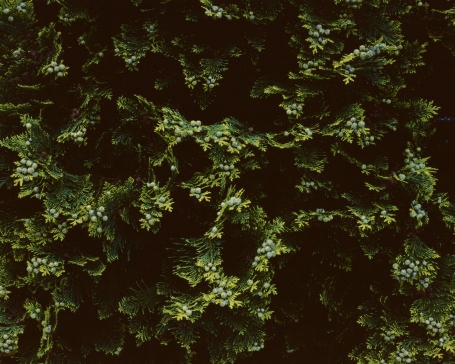
Early in the morning, when night fades away and the pure light of dawn slowly becomes noticeable, the plant world stands still for a moment. The first rays penetrate deep into the foliage, gently, delicately. Gino Bühler captures this moment of silence in the plant world, at the turning point of light, with his analogue large-format camera in a photographic process that is equally determined by light. There must be no breeze, hardly a breath of air to caress a leaf, as the exposure time is long (4-12 seconds) in order to seize his subject in the first light of day. The semi-darkness of the photograph becomes a deep black and even deepest black background in the 18x24cm slide, which particularly emphasizes the subtle elegance of nature in these plant family portraits with leaves from several generations. “Lichtschwarz“ is the deepest black that can be printed.
Bühler’s plant portraits are from our environment, found along roadsides, in gardens, parks or on balconies – not flowers, only one picture shows blossoms – but leafy plants of various kinds. In this respect, they are plants that often accompany our lives unnoticed or unobserved by humans. Yet they are living beings and species that have populated the earth since time immemorial and contributed to the whole and earth’s evolutionary process before there was any sign of our ancestors.
Nothing has been retouched; everything we see is “as is”, and in the 5x slide enlargement we can marvel at the subtleties, rhythm, harmony and splendour of the leaves.
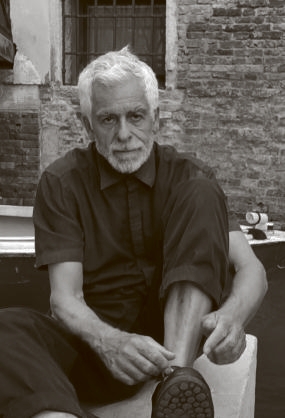
Born in Zurich in 1945, Bühler was connected to nature from an early age as pupil at a Rudolf Steiner school. After attending art school and completing a graphic design apprenticeship, he was drawn to Paris. In the fashion capital of the world he first worked for Le Jardin des Modes – a magazine which alongside Elle was considered the most influential French fashion publication for decades. Paris, at the height of the student revolts of 1968, offered an environment full of contrast and opposites. During the general strike, the young graphic designer rollerskated back and forth between his job on the “rive droite” and the movement on the “rive gauche,” where he lived.
In 1969, he was headhunted by the advertising agency ‘Team’ in Düsseldorf and felt at home in this industry until in 1976 a burnout manifested itself in severe diphtheria. A 9 months hospital stay followed with paralysis affecting 80% of his body for three of the months.
Leaving the advertising industry behind after a lengthy recovery, Bühler teamed up with students from Düsseldorf’s Heinrich Heine University in 1977/78 to found the city magazine Überblick. “The idea was based on Time Out London – there was nothing like it here,” says Bühler. He and two colleagues from the publishing house also started releasing vinyls by the then-female punk band ‘Malaria’ among others, with their newly founded record and concert label Überschall. The evening of a concert with Fehlfarben, Palais Schaumburg, Wirtschaftswunder and DAF in 1982 at the Philipshalle, where punks stormed the stage and danced pogo with DAF, was another turning point in Bühler‘s life.
He now increasingly accompanied his partner Ann Weitz in the world of photography (his familiar territory). Weitz portrait photography focused on ‘LookBook’ presentations for photo models and actors, a market niche that was still largely overlooked in the 1980s.
In 2005, the Berlin gallery Complice presented Bühler‘s first art photography concept, Plan. Here, he already demonstrates his deep connection and understanding of nature. “‚Plan‘ is a term for ‘meadows’, ‘mats’ and ‘pastures’ in the Bregaliotter dialect,” explains Bühler. “We find them in a special region in the Engadin (Maloja/Bergell), which I visited regularly with my father as a child.” Returning in the 1990s, he photographed the flattened meadows of the previous year at the moment of snowmelt, which manifests a concrete process and cycle: over the winter, covered by snow and kept permanently at zero degrees, some (longer, thinner) grasses die. The thick-leaved smaller ones however do not, whereby the decay of the former is converted into fertiliser for the latter. The fascinating, wonderful interconnectedness (also in name) of nature and the venerable cooperation of all its living beings and elements is central to Bühler‘s work.
Photosynthesis, Primordial Forms of Life, is the inaugural exhibition at Thomas Schütte‘s GARAGE art space in Düsseldorf. Through the medium of photography Gino Bühler expresses earth’s life-giving light through a mythical representation of the plantspecies in a myriad of nuanced shapes, which, nourished by the sun, in turn become our food.
Uscha Pohl
Gino Bühler, Photosynthesis, Primordial Forms of Life
GARAGE / Thomas Schütte Foundation
Hüttenstrasse 90, 40215 Düsseldorf
Clockwise from top left: Aaper Wald I, Sorbaria sorbifolia (Sibirische Fiederspiere), Düsseldorf 2019, Botanischer Garten III Bergenia crassifolia (Dickblatt-Bergenie) Düsseldorf 2023; Gino Bühler, photo Ann Weitz; Rheinallee Senecio candivcans (Engelsflügel) Düsseldorf 2022, Botanischer Garten II Heuchera micrantha (Purpurglöckchen) Düsseldorf 2020, Hügelpark (Platycladus orientalis (Morgenländischer Lebensbaum) Essen 2019. Alle Pigmentdruck, bis auf Portrait Gino Bühler

Aaper Wald I Sorbaria sorbifolia, Düssseldorf 2019, Gino Bühler
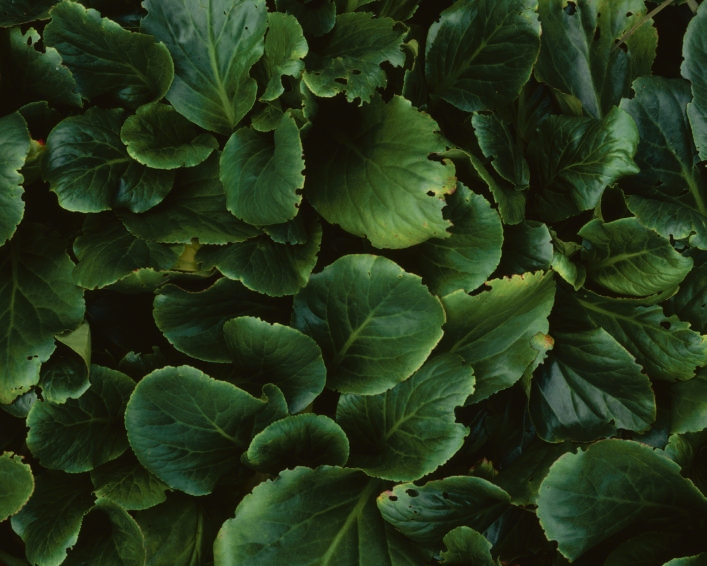
Botanischer Garten III, Bergenia crassifolia. Duusseldorf 2023, Gino Bühler
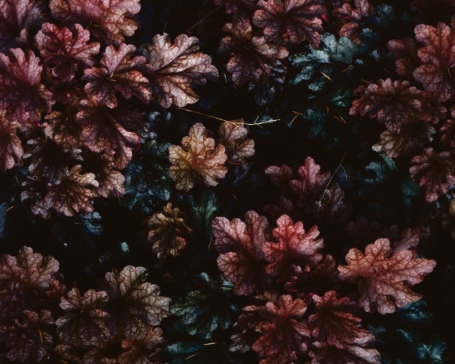
Botanischer Garten II, Heuchera micrantha (purple bells) Düsseldorf 2020
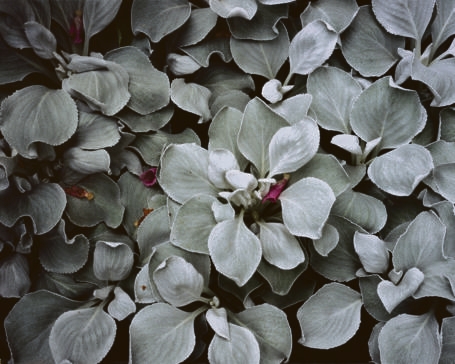
Rheinallee, Senecio candicans (angelwings), Düsseldorf 2022, Gino Bühler